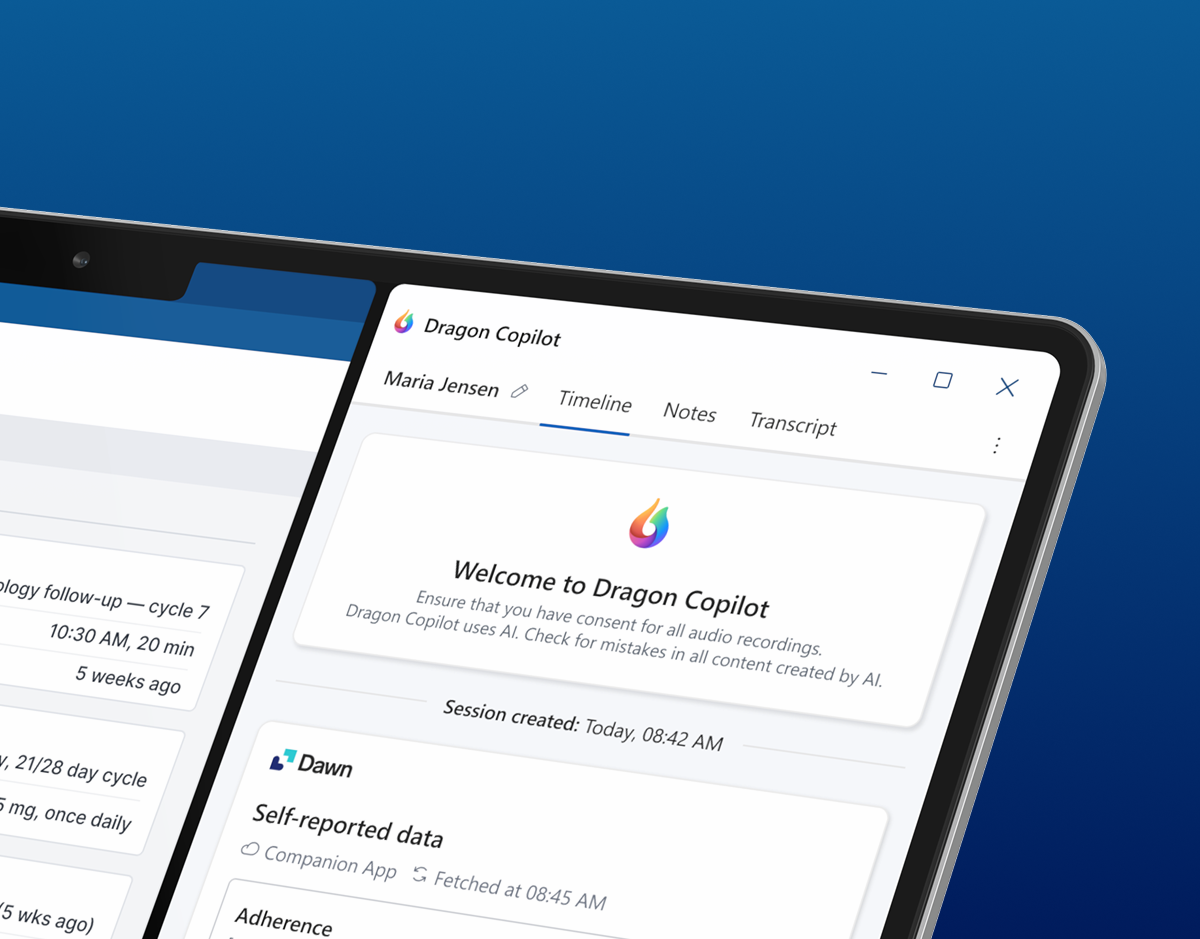
An interview-style article with Johannes Boshkow, Head of Partnerships at Dawn Health, on the new Dragon Copilot Integration by Dawn Health.
Patients forget 40–80% of medical information from a consultation ¹, and nearly half of what they remember, they remember wrong. ²
Clinicians already have access to more information than ever, enabling increasingly informed and individualized treatment decisions. However, what they can't see is what happens once the patient goes home, and that's where many good decisions are never carried out.
"Physicians write prescriptions knowing a significant share of patients won't follow through exactly as intended. Take an inhaled corticosteroid for persistent asthma: while most patient believe they're using their inhaler correctly, only less than half (31%) apply the correct technique³.” explains Johannes.
"Six months on, the physician sees uncontrolled asthma and cannot tell whether the drug failed or was never delivered. It was still the best decision available at that moment. But what happens after the prescription is a separate problem entirely."
Partial fixes already exist - i.e. teach-back methods, written summaries, visit-prep prompts, and others - but these are implemented inconsistently, dependent on the clinician's time and habits, contributing to uneven applications across the system.
In the absence of something consistent, patients have taken matters into their own hands. Emerging data shows that patients use general AI to interpret symptoms, prepare questions, and understand diagnoses ⁴ ⁵, reporting the same frustrations either way.
The mismatch between how much gets discussed in a consultation and how little time there is, costs follow-through, despite the common assumption that the real problem is a lack of data.
"It's only natural that a patient walks out of a routine appointment with three or four different instructions - this one now, this one only if something happens, this one starting next visit - and realizes on the way out that they've already lost track of what is which.
This is what happens when a lot gets said in very little time, and the current structure doesn't support quick follow-up or continuous tracking."
The Dragon Copilot Integration by Dawn Health is the first to fully integrate patient intelligence into the clinical workflow and back to the patient-facing companion app, closing the gap between clinical decisions and patient follow-through.
The test lies in whether the decisions made during the appointment are carried out in patients’ daily life. In practice, this can look like: a verbal instruction that flows directly into the patient's reminder, exactly as given; or a diagnosis or clinical note available to patients in comprehensible language. All of this without adding direct post-consultation touchpoints.
"When a patient receives a report full of accurate medical language without something to translate it into comprehensible terms and actions, weeks can pass before that patient understands what their physician already knows,”
This is one of many examples where something might read as urgent to a physician, while it remains ambiguous, or even falsely reassuring to the patient holding it.
“(...) Patients are ultimately the ones responsible for following their treatment plan in the weeks between appointments, yet the information gets lost in translation."
The ambition is for patients to leave the consultation with an accurate, retained understanding of their treatment plan, while clinicians gain the confidence that decisions will be carried forward to every subsequent moment of the patients' care journey. Because the Dragon Copilot extension is built where clinicians already work, that reliability is designed to carry across the care journey without any additional steps.
The result is something the category has rarely delivered: reliable continuity of care, post-consultation.
As Johannes puts it, “This is physician-driven, but patient-centric, and those two things didn't really exist together before."
The adherence gap has always been treated as an unfortunate constant, a known failure built into the system, as much human as it is structural.
The Dragon Copilot Integration by Dawn Health is built on a different premise: that what is decided by a clinician can confidently be acted on after the consultation, enabling patients to understand their treatment, take ownership of their care, and sustain both motivation and adherence current therapies depend on.
Scaled across every appointment, that is what a more connected standard of care looks like.
_
Dawn Health is a Strategic Global Partner of Microsoft on the Dragon Copilot Ecosystem.
Read more about the new Dragon Copilot Integration by Dawn Health on https://www.dawnhealth.com/microsoft-dragon-copilot
References
- Kessels, R. P. C. (2003). Patients' memory for medical information. Journal of the Royal Society of Medicine, 96(5), 219–222.
- Anderson, J. L., et al. (1979). Patient information recall in a rheumatology clinic. British Journal of Rheumatology, 18(1), 18–22. https://doi.org/10.1093/rheumatology/18.1.18
- Sanchis, J., Gich, I., & Pedersen, S. (2016). Systematic review of errors in inhaler use: Has patient technique improved over time? Chest, 150(2), 394–406. https://doi.org/10.1016/j.chest.2016.03.041
- Ding, W., & Wang, J. (2026). Generative artificial intelligence (AI)-assisted self-diagnosis and the patient-physician relationship: Mixed methods study of calibration, participation, and trust. Journal of Medical Internet Research, 28, e95072. https://doi.org/10.2196/95072
- Blease, C., et al. (2026). Patient and family perspectives on generative AI tools in rare diseases: Exploratory mixed methods online survey. Journal of Participatory Medicine, 8(1), e93720. https://doi.org/10.2196/93720
DHDK_WEB_DragonCopilot_08_V0
